Marklet is a tiny, native macOS editor where syntax melts into formatting as you type. No preview pane. No Electron. Just your .md files, beautifully editable.
Marklet styles your Markdown in place. Markers vanish where your caret is not and come back the moment you go in, so the file you edit is the file you read. Hover any line below to bring its syntax back, or reveal the whole document at once.
# Release notes
A single pane where the source is the preview. **Bold**, _italic_, ==highlight==, ~~struck~~, `inline code`, and [links](https://getmarklet.com).
## Shipping this week
Live formatting for every inline element
Tables you can edit cell by cell
Mermaid diagrams
- Bullets draw as real bullets
- Nested items shift one level in
| Element | Renders | Editable |
|---|---|---|
| Table | A grid that stays a grid | Yes |
| Math | SwiftMath image | Yes |
// about 190 languages let editor = NSTextView(frame: .zero) editor.layoutManager = EditorLayoutManager()
Inline math like $e^{i\pi} + 1 = 0$eiπ + 1 = 0 sits on the baseline, and $5 stays five dollars.

---
Everything above is one plain text file on your disk. Open it in any other editor and nothing is missing.
Bold, italic, bold plus italic, highlights, strikethrough, inline code, links, heading markers, escape backslashes, and whole image expressions all collapse when the caret leaves them. Nothing is retyped and nothing is converted: the markers are simply hidden in place.
`**bold**` keeps its asterisks**Milestones** for *this* quarter
Ship the ==editor core==, then ~~rewrite it~~
Read the [notes](notes.md) first
Return continues a bullet, an ordered item, or a task. Return on an empty item exits the list. Tab and Shift Tab indent and outdent, wrapped lines hang under the content instead of under the marker, and ⌘L turns any line into a checkbox.
Draft the changelog
Cut the release build
Upload to App Store Connect
Pipe tables draw as a grid and stay a grid. Click a cell to edit it right there, Tab to the next one, and Tab from the last cell to add a row. Right click for row and column operations and column alignment. Cells render their own inline Markdown, including code, links, and images.
| Build | Size | Engine |
|---|---|---|
| Marklet | 11 MB | AppKit |
| Electron app | 285 MB | Chromium |
Fenced blocks get language aware highlighting for roughly 190 languages, themed separately for light and dark mode. The background runs the full width of the line, and the copy button shows the language name and copies the contents without the fences.
func highlight(_ range: NSRange) { // only the edited paragraph applyIncremental(range) }
Block formulas between $$ render centered through SwiftMath. Inline formulas between single dollars render on the baseline and collapse to exactly the width they need. Prices like $5 and $1,000.50 are left alone by a currency heuristic, and an escaped dollar sign never opens math at all.
Coffee costs $4.50, which is not math.
Blockquotes draw a vertical accent bar per nesting level. Callouts written as > [!note] pick up the accent color, a tinted background, and the conventional SF Symbol for their type, covering the full GitHub and Obsidian type set plus aliases. Add your own title and it becomes an accent colored headline.
> > text stack their bars> [!note] line under the render.
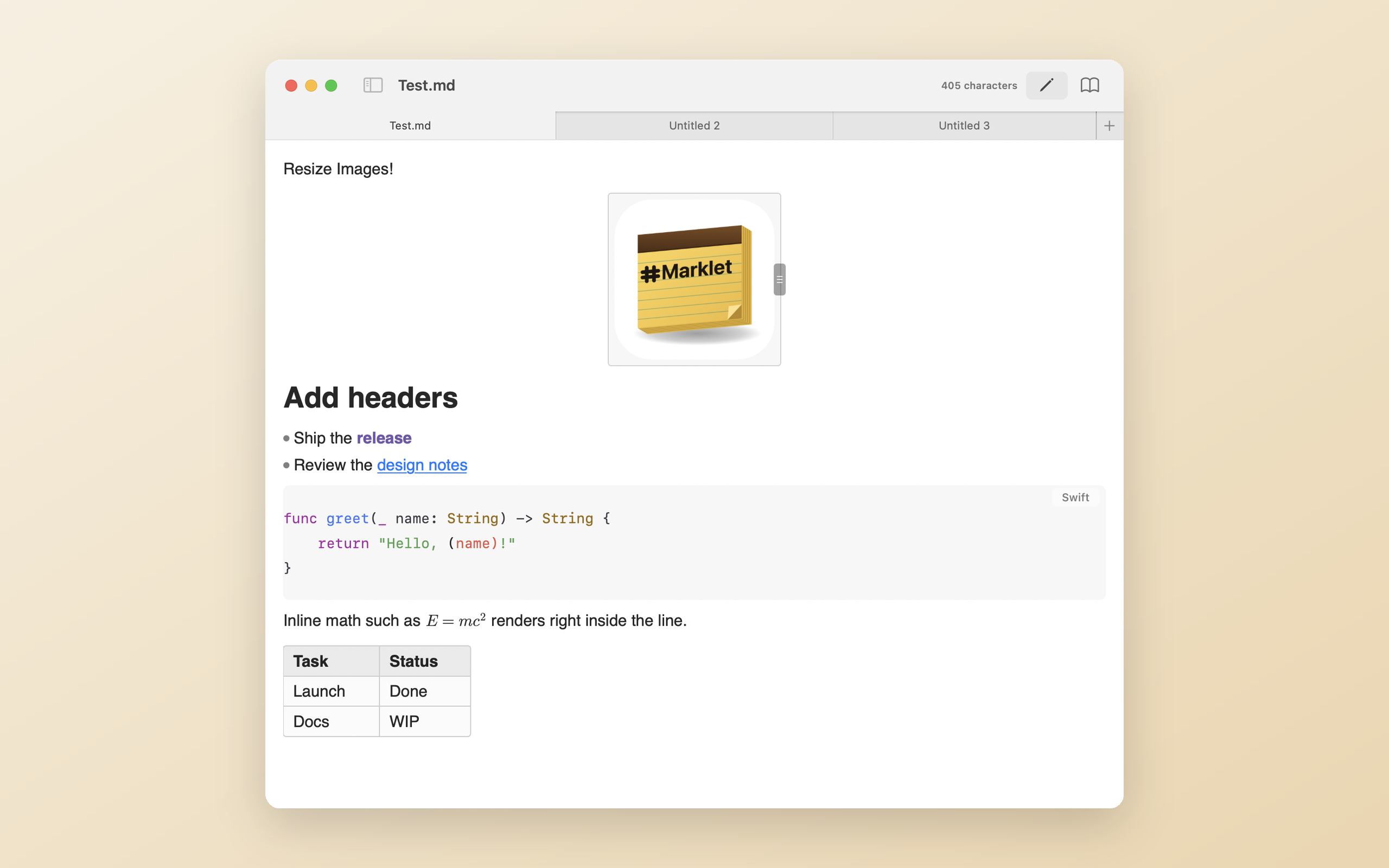
Local and remote images preview under their source line, centered, at their real dimensions, so nothing leaves a band of empty space. Drag the grip on the right edge to resize, and Marklet writes the width straight back into the alt text as .

Real window tabs, the real find bar, the real font panel, the real title bar rename popover. Marklet is an AppKit text view with a custom layout manager, so every macOS text behavior you already have muscle memory for is simply there.
Pick any font through the native font panel, keep code monospace or let it follow the editor font, and set bold, italic, highlight, and code colors with separate wells for light and dark. Structural spacing has Compact, Normal, and Relaxed presets plus a fine tune slider, and body line spacing has its own.
The whole app is about 11 MB, native builds for Intel and Apple silicon included, because there is no browser inside it. Typing restyles only the paragraph you touched instead of the whole document, and every regular expression and parse result is cached for the pass.
Curious how that stacks up against the editor you use now? See the full comparison.
Marklet is small, but it is not thin. Here is the whole feature set.
Mermaid diagrams, footnotes, and reference style links are not here yet, and neither is a dedicated HTML export. Raw HTML in a document is not handled at all, so it sits there as plain text. Most of that is what 1.2 is aimed at: HTML support and full CommonMark and GitHub Flavored Markdown coverage. If one of these is the reason you would not switch, say so on the support page and it moves up the list.
Small, native, and $2.99 $0 for the launch window. Your notes never leave your Mac.